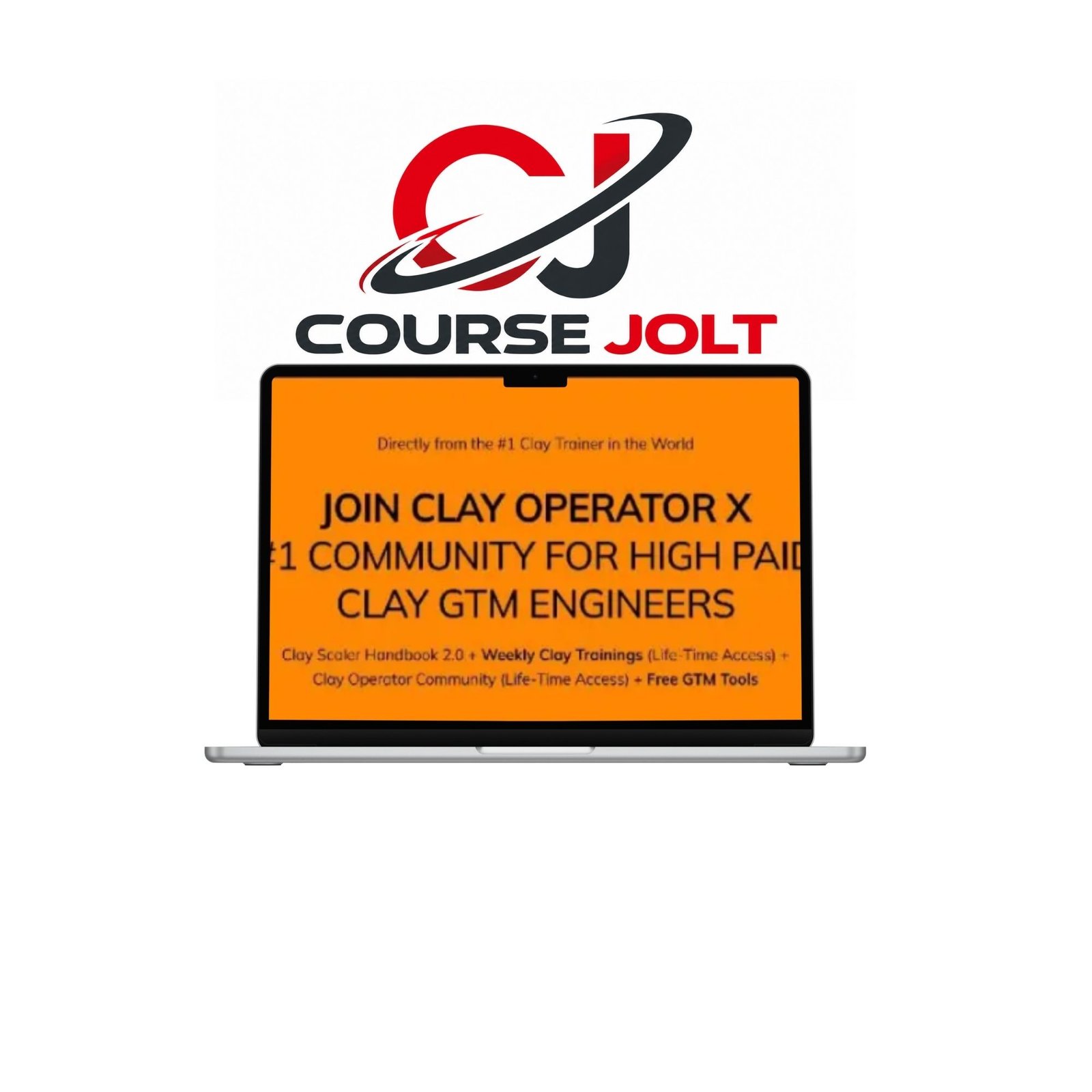
Michael Saruggia – Clay Operator X (2026)
Original price was: $99.00.$25.00Current price is: $25.00.
Explore Clay-powered go-to-market systems with Michael Saruggia – Clay Operator X (2026). Learn about lead generation, data enrichment, prospect research, CRM workflows, sales automation, and personalized outbound strategies. Designed for aspiring GTM engineers, marketers, freelancers, and business professionals interested in using Clay to build more organized and scalable B2B sales and marketing processes.
Contact us directly to receive your payment link.
🟢 Get Payment Link on WhatsAppChat with us on WhatsApp for instant assistance.
🟢 Get Payment DetailsDescription
Course Overview
Michael Saruggia – Clay Operator X (2026) is a learning opportunity for people interested in Clay, go-to-market (GTM) engineering, B2B lead generation, data enrichment, and sales workflow automation.
Modern businesses rely on accurate prospect information, well-organized customer data, and efficient sales processes to connect with potential customers. Managing these activities manually can become time-consuming as a company grows. Tools such as Clay can help businesses combine data sources, enrich prospect records, and build workflows that support sales and marketing operations.
Michael Saruggia works in the Clay and GTM engineering space, with an emphasis on building and teaching systems for B2B growth. His public profile describes work involving outbound prospecting, inbound lead flows, CRM enrichment, and Clay integrations. These areas provide the broader context for understanding Clay Operator X.
Understanding Clay and GTM Engineering
Go-to-market engineering brings together technology, data, automation, and business strategy to improve how companies identify, reach, and convert potential customers.
Rather than relying entirely on manual research and repetitive administrative work, GTM teams can use connected tools and structured workflows to support prospecting, lead qualification, customer-data management, and outreach preparation.
Clay is a platform used for data enrichment and sales research workflows. It can help users gather information about companies and contacts, combine data from different sources, and apply automation to selected research and qualification tasks.
Understanding how these capabilities fit into a broader GTM system is useful for marketers, sales professionals, consultants, and people exploring a career in GTM engineering.
Lead Generation and Prospect Research
Lead generation involves identifying people or organizations that may be interested in a product or service. Effective prospecting begins with a clear understanding of the target audience and the characteristics of a suitable potential customer.
Clay-based workflows can support this process by helping users organize prospect lists, enrich records with additional information, and identify relevant characteristics for segmentation.
Important considerations include defining the ideal customer profile, selecting appropriate data sources, checking information quality, and maintaining accurate records. A well-organized prospecting process can help sales teams spend more time evaluating relevant opportunities and less time on repetitive research.
Data Enrichment and CRM Management
Customer relationship management (CRM) systems store information about prospects, customers, interactions, and sales opportunities. However, records can become incomplete or outdated as people change roles, companies expand, and business information changes.
Data enrichment helps supplement existing records with relevant information from available sources. Clay can support enrichment workflows that connect prospect research with CRM data management.
A structured process may involve identifying missing fields, retrieving relevant information, validating results, and updating records according to appropriate business rules.
Data quality is essential. Users should review uncertain information, avoid unnecessary duplication, and follow applicable privacy requirements when handling personal or business contact data.
Building Automated Sales Workflows
Sales workflows often include multiple steps, from researching potential customers to organizing leads, preparing outreach, and recording responses.
Automation can help coordinate these steps and reduce repetitive manual work. For example, a workflow might categorize prospects according to selected criteria, enrich company records, or prepare information for a sales representative to review.
The purpose of automation is not simply to perform more actions. It is to create a dependable process with clear inputs, useful outputs, and appropriate checks.
Learners exploring Clay and GTM engineering can benefit from understanding how workflows are designed, tested, monitored, and improved over time.
B2B Outbound Strategy and Personalization
B2B outbound marketing involves contacting potential business customers who may benefit from a company’s products or services. Successful outreach depends on selecting relevant prospects, understanding their business context, and communicating a clear reason for making contact.
Data enrichment can help provide context for personalized communication, while segmentation can help teams organize prospects according to industry, company characteristics, or other relevant criteria.
Personalization should be accurate and useful rather than based on unsupported assumptions. Outreach should also respect privacy rules, applicable marketing regulations, platform policies, and recipient preferences.
A thoughtful outbound process combines research, relevant messaging, responsible data practices, and ongoing evaluation.
Inbound Lead Flows
Inbound leads are potential customers who express interest in a business through channels such as website forms, content, or other marketing activities.
A well-designed inbound process helps teams collect relevant information, identify suitable opportunities, and direct leads to the appropriate next step.
Automation may support tasks such as enriching incoming records, organizing leads, checking for duplicates, and routing qualified prospects to the right team.
The effectiveness of an inbound workflow depends on how accurately it captures information, how quickly the team responds, and how well the process aligns with the company’s sales strategy.
AI and Sales Operations
Artificial intelligence can support selected sales and marketing tasks by helping interpret information, classify records, summarize research, and assist with content preparation.
When combined with data tools and automation platforms, AI may become one component of a larger GTM workflow. However, AI-generated information can be incomplete or incorrect, so important details should be verified before they are used in customer communications or business decisions.
Learning to combine automation with human review is an important part of building reliable sales systems.
From Technical Skills to GTM Services
GTM engineering combines technical implementation with an understanding of business problems. Building a workflow is only one part of the process; users must also understand why a company needs it and how its performance will be evaluated.
People exploring this field can develop skills in prospect research, data organization, workflow design, CRM integrations, and sales-process analysis.
Consultants and freelancers may apply these skills when helping organizations improve their sales operations. However, attracting clients and building a sustainable service business also require communication, project management, market understanding, and consistent delivery.
Course participation alone does not guarantee employment, clients, or income.
Who Can Benefit from Clay Operator X?
This course may be relevant to:
- Aspiring GTM engineers interested in combining data, technology, and sales operations.
- B2B marketers exploring automated prospect research and lead-generation workflows.
- Sales professionals who want to understand data enrichment and more organized prospecting.
- Freelancers and consultants interested in developing technical services for business clients.
- Agency owners exploring ways to improve lead-generation and CRM processes.
- Entrepreneurs interested in understanding the systems that support B2B customer acquisition.
- Beginners in sales technology who want to explore Clay and the broader GTM engineering field.
The exact prerequisites, lesson structure, and level of support available should be confirmed using the official course information.
Potential Learning Areas
Based on the broader Clay and GTM engineering field, relevant areas to explore include:
- Understanding Clay and its role in sales and marketing operations.
- Defining target audiences and ideal customer profiles.
- Organizing prospect lists and researching companies.
- Enriching contact and company records.
- Designing repeatable data-processing workflows.
- Understanding CRM enrichment and integrations.
- Exploring inbound lead management and outbound prospecting.
- Evaluating workflow accuracy, reliability, and efficiency.
- Applying responsible data-handling and outreach practices.
These are general topic areas, not a verified list of the exact lessons included in Clay Operator X.
Final Thoughts
Michael Saruggia – Clay Operator X (2026) is relevant to learners interested in the intersection of Clay, lead generation, B2B sales operations, data enrichment, and GTM engineering.
Understanding these areas can help learners explore how technology supports modern sales and marketing processes. By combining practical tool knowledge with business reasoning, data quality checks, and responsible automation, learners can build a stronger foundation for understanding the GTM engineering landscape.
Related products
-
Sale!

Gregory John-Build an AI agent platform with Claude Agents (2026)
Original price was: $99.00.$20.00Current price is: $20.00. -
Sale!

Lobo Brothers – Elite AI Automation Growth Hub (2026)
Original price was: $27.00.$20.00Current price is: $20.00. -
Sale!

Sam Woods – Agent Operating System (2026)
Original price was: $497.00.$40.00Current price is: $40.00. -
Sale!

Kirk Arkman-Digital Automation Diagram (2026)
Original price was: $499.00.$45.00Current price is: $45.00.
Reviews
There are no reviews yet.